Why You Compare Yourself to People Who Aren’t Even Competition
Ever watched some woman lounging on a billionaire’s yacht and thought, “What an amazing life”? Of course you have. There’s no version of you that hasn’t compared yourself to someone who isn’t even in your race. Honestly, that doesn’t mean you can never get there. It means you can — but only once you stop comparing and start asking a better question: how did they build it? instead of “look how good they have it.”
To be fair, this isn’t really your fault. Society wired our brains this way long before we had a say in it. This article is about unlearning that with honest, occasionally embarrassing stories. Let’s start with the brain science, because understanding why you do this is the first step to doing it less.

What Is Social Comparison, Really?
You already have a gut sense of what social comparison is. But it’s not just “comparing yourself to people you know.” Psychologist Leon Festinger formalized this back in 1954 with his Social Comparison Theory: humans evaluate their own abilities and opinions by measuring themselves against others, because we don’t have an objective yardstick for most things in life — so we borrow other people as one.
There are two flavors:
• Upward comparison — measuring yourself against someone perceived as better. (The classic: “How does she never study and still top the class?”)
• Downward comparison — measuring yourself against someone perceived as worse off.( when you see someone struggling with health issues your brain goes “at least I am healthier than him.”)
Upward comparison can genuinely motivate you — or it can quietly wreck your self-esteem, depending on how you hold it. Meanwhile, downward comparison can boost confidence and gratitude — or make you complacent. Neither is inherently good or bad. Your brain, left unsupervised, defaults to upward comparison until it feels sufficiently threatened, at which point it goes hunting for a downward comparison to feel better. It’s not subtle.
Why Your Brain Won’t Stop Comparing You to Everyone
I spent four years as a flight attendant, surrounded by people who were, by any measure, beautiful, elegant, and put-together — myself included. And still, my brain found differences constantly.
“She looks great with bangs.”
“She’s basically a model.”
The funny things is everyone else’s brain was doing the exact same thing to me. I’d get asked what lipstick shade I used, or how I “looked so different” from everyone else. We were all quietly comparing and being compared to, simultaneously, and nobody was winning.
Some comparison is useful — it’s your brain trying to help you calibrate and improve. It tips into unhealthy territory the moment it starts asking, “Why am I not as pretty as her?” or “What’s wrong with me?” In other words, that’s not calibration anymore. That’s self-sabotage in disguise.
Broadly, your brain compares you to others for four reasons:
• Understanding where you stand
• Learning and improving faster
• Staying socially accepted
• Spotting opportunities and threats
Why You Compare Yourself to People Who Aren’t Even Your Competition
This is the real point of this article. For years I compared myself to people 10–20 years ahead of me — which was never a fair fight, because they’d already absorbed a decade or two of obstacles I hadn’t hit yet. We do this constantly: measure ourselves against people on a completely different timeline, with completely different goals, and call the resulting gap a personal failure.
Nobody post how hard it was to reach success. What they post casually is, “I made it.” And there’s no such thing as “made it,” because if there were, that would be the end of the story — and the story never actually ends.
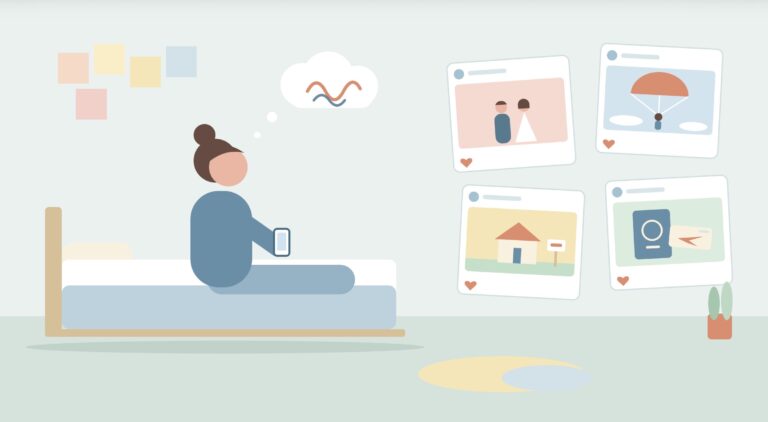
What we’re wired to consume is the highlight reel, not the reality. That’s precisely why we compare ourselves to people who were never our competition to begin with — the brain builds a quick fantasy of you in that position, assuming you have already achieved all of it. Then you scroll to the next reel and do it again, to someone else, for something else.
The actual fair comparison you should do is you, today, against the person you were yesterday. That’s the only one with a level playing field.
The Hidden Cost of Constant Comparison
We live in a world engineered for unlimited exposure to other people’s lives — every scroll, every second, online or off. That constant exposure to other people’s highlight reels is exactly what keeps the comparison spiral running on autopilot.
The more you consume, the more “behind” you feel — behind on the promotion, the relationship, the trip. That’s usually followed by a low hum of fear-of-failure, and an inability to enjoy your own wins, because your brain is still busy processing everyone else’s highlight reel.
The core problem isn’t comparison itself. It’s information overload. The more you know about everyone else’s life, the harder it becomes to feel good about your own — which is, not coincidentally, why you were happier as a kid with no Instagram and a flip phone you weren’t allowed to touch after 8 p.m.
Healthy Comparison vs. Toxic Comparison
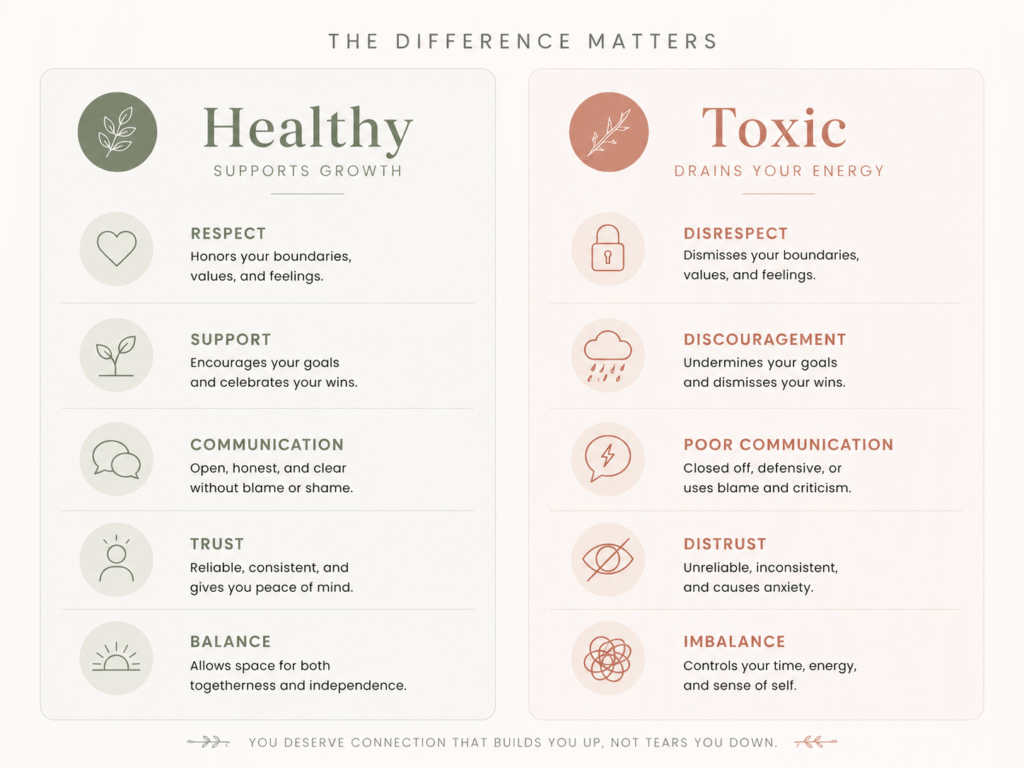
I didn’t learn this distinction from a book. I lived two years of pure toxic comparison at the age of 23–24, and two years of (mostly) healthy comparison at 25–26. The lesson: healthy comparison isn’t automatically good, and toxic comparison isn’t automatically bad. Before we head to the reason let’s first understand the differentiation between:
| Healthy Comparison | Toxic Comparison |
|---|---|
| Inspires action and self-improvement | Leads to discouragement and self-criticism |
| Recognizes everyone starts from a different point | Assumes everyone has identical opportunities |
| Driven by curiosity and growth | Driven by insecurity and self-doubt |
| Encourages realistic goals | Creates perfectionism and unrealistic expectations |
| Compares present-you to past-you | Compares you to someone else’s highlight reel |
| Accepts that progress takes time | Expects instant success, feels “behind” instantly |
The part that nobody says out loud is, I’m genuinely grateful for the toxic phase. I wouldn’t have recognized healthy comparison without living through the alternative first. If you’re currently deep in toxic-comparison territory, you’re not broken — you’re on schedule. The move isn’t to eliminate toxic comparison overnight. It’s to keep tilting the ratio toward healthy, on purpose, every day. After countless experiences I finally managed to redirect my energy in the right direction by using…
The R-E-S-E-T Framework: How to Break the Comparison Cycle
This is the practical part. Use the acronym R-E-S-E-T the next time a comparison spiral starts:
R — Recognize the trigger point.
What just triggered this? Notice the post, person, or platform before the spiral goes automatic.
E — Examine the comparison.
Why am I comparing my career to their financial success — two completely different scoreboards? Bring it into conscious awareness before it runs on autopilot.
S — Select the relevant models.
Is this person even relevant to my goals, values, or circumstances? If not, this comparison was never fair to begin with.
E — Evaluate values, not vanity.
Am I actually admiring discipline and creativity, or just status, likes, and a yacht? Be honest — it’s usually the yacht.
T — Turn back to your goals.
What can I actually extract from this and put toward my own path? Redirect the energy you just spent envying someone else’s life back into building yours.
Comparison turns toxic when it pulls you off your own path. It turns healthy the moment it points you back to it.
Real-Life Case Studies (a.k.a. Things That Actually Happened)
Case Study 1: Shreli.
Four years of friendship, and nearly every conversation was Shreli comparing herself to ten people a day, ending most nights crying with some version of “I’ve done literally nothing with my life.” After enough gentle (and eventually less gentle) reality-checks, it clicked. She’s now happily settled in Germany.
Case Study 2: The 10th-grade topper.
My classmate — a perpetual topper who considered anything under 100% a personal failure — once scored her “lowest ever”: 96.9%, edged out by someone at 97%. Her mother showed up to argue with the teacher, who had gently told her daughter, “Your score doesn’t define your life. Work hard and do better next time.” However, the mother wanted her scolded instead. That same friend today works a 9-to-5 that takes 100% of her energy and pays roughly half of what it’s worth. Chew on that one.
Case Study 3: The content creator.
A friend with two million followers across platforms — genuinely talented at holding attention. When we caught up recently, she spent the whole conversation trying to understand my perspective of her, to fuel more content. While she was in it, I was personally fighting the spiral. Am I actually doing anything with my life? Have I achieved anything good so far? Healthy admiration, curdling into toxic self-comparison, in real time. R-E-S-E-T dragged me back before it went further.
We’re humans. After all, You’ll read this, nod along, and still get pulled back into comparison mode within the week. That’s fine — that’s the deal. The goal was never to stop comparing forever. It’s to catch yourself faster each time.
5 Tips to Control Comparison
1. Limit algorithm-driven scrolling. You already know where the toxic spiral starts. Cap it, and watch your baseline mood shift within days.
2. Audit your environment. Sometimes the comparison isn’t even coming from your own brain — it’s your mom mentioning your cousin’s engagement for the third time this month. Set boundaries. Protect your peace, even from family.
3. Practice self-compassion. Talk to yourself the way you’d talk to someone you actually love. Be kind to yourself the way you’d be kind to any other human being having a rough week.
4. Define personal success on your own terms. Is it actually the Lambo and the yacht — or is it a quiet, steady life and people who love you? Figure out which one is genuinely yours before you spend a decade chasing the wrong one.
5. Use comparison as information, not identity. Easier said than done, but trainable. Every time you catch a comparison spinning up, run it through R-E-S-E-T instead of letting it define how you feel about yourself for the rest of the day.
5 Common Comparison Mistakes (and How to Stop Making Them)
1. Comparing outcomes instead of inputs. Your brain wants a million views on day one. The actual “input” behind a million views is 365 days of unglamorous, consistent posting nobody claps for.
2. Comparing different life stages. Author Jon Acuff put it better than I can: “Don’t compare your beginning to someone else’s middle.”
3. Ignoring context. Without the real story behind someone’s success, your brain fills in the blanks with a fantasy. Dig for context before you crown someone “lucky.”
4. Chasing validation. That aesthetic caption you agonized over — was it for your own memories, or for one specific person who didn’t even like the post? Be honest with yourself here; it changes everything downstream.
5. Believing social media is reality. It’s the adult version of believing a bear will eat you if you don’t sleep by 10 p.m. A comforting story, engineered by someone else, that was never actually true.
Final Thoughts
Theodore Roosevelt called comparison “the thief of joy” — and he wasn’t wrong. But it’s also just… deeply human. It helps us learn, adapt, and grow, when we let it. The problem was never that we compare. It’s how and why.
When comparison starts pulling you away from your own goals and into a loop of insecurity and self-sabotage, that’s your cue to R-E-S-E-T and come back to yourself. There will always be someone further ahead than you, living the life you think you want. There will also always be someone just getting started, wishing they were where you are right now.
The only comparison that actually matters: are you a little wiser, kinder, and stronger than the version of you from yesterday? That’s not a race against anyone else. It’s the only competition that was ever real.
If your brain needs regular help remembering that — the newsletter exists for exactly that reason. Subscribe, and let’s keep each other out of the comparison spiral, once a week.