
Rest vs Avoidance: How to Tell the Difference(Before It Costs You Years)
Have you ever told yourself you were “too tired” to do something, decided to rest, and then somehow just… never did it?
That’s the trap. You think you’re resting. You’re actually avoiding. And the two feel identical from the inside — which is exactly why so many of us stay stuck in rest vs avoidance confusion for years without noticing.
I know, because I did it for four years.
As a former flight attendant, my life was jet lag, short layovers, and constant motion. If you’ve ever actually lived that schedule — not just heard about it — you know it’s brutal in a way that doesn’t show up on Instagram. I was fighting for real rest constantly, and I kept using that exhaustion as a permission slip to avoid the one thing I actually wanted: to start something of my own.

It’s a special kind of sad, knowing you have the potential to do something and watching yourself not do it — not because you can’t, but because “resting” became a very comfortable hiding spot.
Eventually I got out of the trap, and I figured out exactly where the line is between genuinely resting and quietly avoiding. Let’s get into it.
What Is Rest?
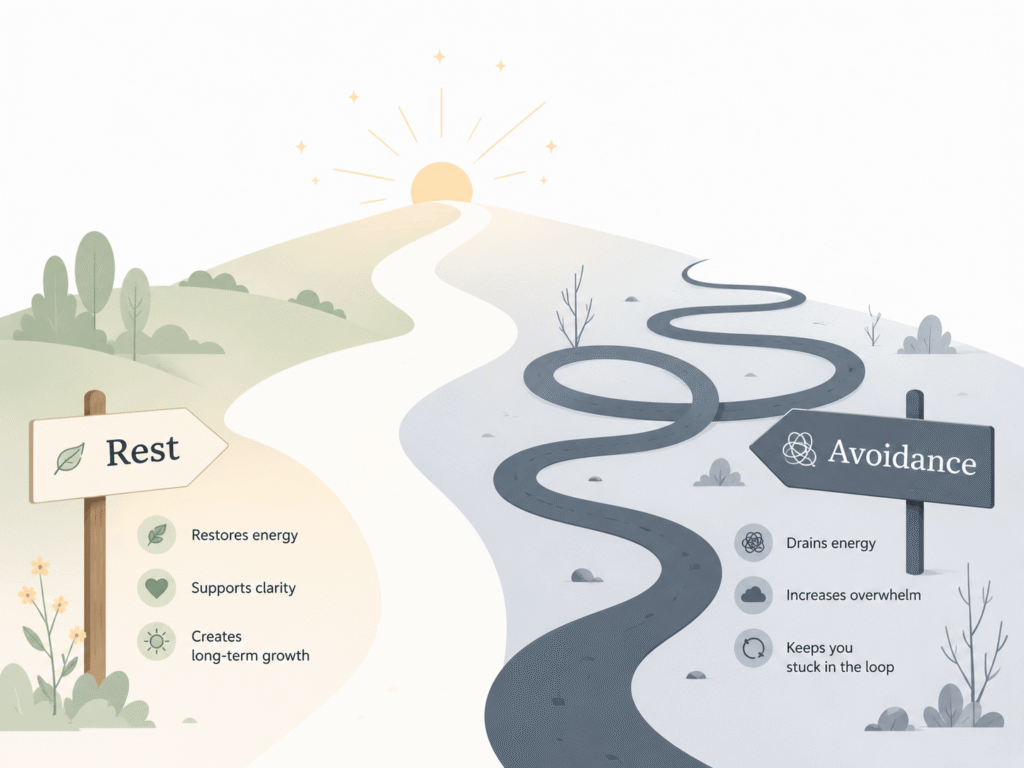
Rest is an intentional act you do to recover your physical, mental, or emotional energy so you can function well again.
Your brain is wired for this. No matter how disciplined you think you are, there’s a point where your body stages a quiet mutiny — eyes closing, focus dissolving — and makes the decision for you. Rest isn’t optional. It’s maintenance.
“Rest is a deliberate pause that restores your ability to engage with life. The purpose is recovery, not escape.”
“I’ve been working nonstop lately. I think I need a break.”
That’s rest talking. You’re aware you’re tired — physically, mentally, or both — and you’re choosing to address it. You’re still in the driver’s seat.
What Is Avoidance?
Avoidance is your brain finding reasons not to do something that’s uncomfortable right now but good for you later.
“You’re choosing short-term relief over long-term well-being.”

This one stings a little, and it should. Avoidance isn’t good for your mental or physical health, and here’s the annoying part: it feels good in the moment. It buys you emotional stability for the next hour, in exchange for a bigger, blurrier bill later. You avoid the task, your anxiety drops, and your brain quietly files that away as “Great! that worked, Let’s do it again.”
Rest vs. Avoidance: The Core Difference
Scenario 1:
You get home from your 9–5 with a business idea buzzing in your head. You’ve got the skills and the resources. Your brain says:
“I’ll take a 30-minute nap, then start my first task.”
You actually do it. That hit of real, earned dopamine at the end of the day makes you want to do it again tomorrow. That’s rest working exactly as designed.
Scenario 2:
Same 9–5, same exhaustion, same idea in the back of your mind — the one that could eventually get you out of the grind. But your brain has a different pitch this time:
“Be kind to yourself. You’ve worked enough today. Rest today, start the business on your day off.”
Comfortable. Reasonable-sounding. And also a trap, because deep down you know “my day off” is doing a lot of quiet, unpaid work to keep you exactly where you are. That’s not you making a call — that’s your brain’s discomfort-avoidance system making it for you.
| Rest | Avoidance | |
|---|---|---|
| Nature | Intentional | Happens subconsciously |
| Effect on energy | Restores it | Drains it |
| Duration | Temporary | Endless |
| Long-term effect | Builds resilience | Reinforces fear |
| Payoff | Good for long-term comfort | Good for right-now comfort only |
Why Avoidance Feels Exactly Like Resting
There’s a thin line between avoidance and procrastination too — the difference being that when you’re procrastinating, some part of you is still planning to do the thing eventually. Avoidance doesn’t even bother with the plan. It just quietly deletes the task from your to-do list without telling you.
Most of the time we think we’re resting, and we just… forget what we were supposed to do. That’s not an accident. That’s the point. You never seriously committed to the task in the first place, so your brain treats forgetting it as a small win.
No task = no anxiety = cheap, reliable dopamine. Your brain will keep cashing that check as long as you let it.
Signs You’re Truly Resting
Since I left the airline job, I’ve gotten a lot better at spotting real rest. Here’s what it actually looks like:
1. You choose the break on purpose. You decide on a time for it and you stick to that window — it’s not an open-ended disappearance.
2. You don’t feel like you have to “earn” it. I used to walk into hotel rooms thinking I earned this. Rest that requires a receipt isn’t rest, it’s a reward system — and you don’t need to perform exhaustion to be allowed to recover.
3. Your energy actually comes back. The drained, foggy feeling lifts. That’s the whole point of rest — if it’s not happening, something else is going on.
4. You’re willing to start again. Even if the work is still hard, you have the will to return to it.
5. It supports where you’re actually trying to go. You come out of it thinking “okay, 30 minutes was enough, let’s go” — not “I’ll deal with it eventually.”
Signs You’re Actually Avoiding
Back when I was working full-time and trying to will a side project into existence, I recognized every single one of these in myself:
1. “I’ll do it later” is your go-to line. This one sounds like procrastination, but if “later” never actually arrives, it was never really on the schedule — it was a polite way of saying no to yourself.
2. You feel instant relief the moment you drop it. “I want to clean my room, but that’s a lot. I’ll do it later — let’s just watch one more episode.” That relief is exactly what keeps the loop running.
3. The task keeps getting bigger the longer you dodge it. The laundry pile doesn’t wait patiently. Neither does the inbox, the business idea, or the studying.
4. You consume instead of create. Watching someone else build the thing you want to build feels like participation. It isn’t. It’s usually fear wearing a comfortable disguise — “what if I fail, what if people I know see this and judge it” — followed by the guilt spiral of “I should be doing something right now.”
5. It costs you more stress later, not less. Study for an exam five days out and you’re calm by day four. Cram it into the last night and you’re panicking at 2am wondering how you’re supposed to learn a semester of material before sunrise. Same exam. Wildly different experience, and it was avoidance that made the difference.
Real-Life Examples of Avoidance
Students before exams. I never once studied on schedule in college. Every “I should start studying now” got answered with “I’ve still got three months before exams .” That math never worked out in my favor, and my grades were the receipt.
Employees avoiding emails. At my first job, I was behind on a sales target, and instead of replying to my manager’s follow-ups, I avoided the inbox entirely. Twenty-one-year-old me didn’t understand yet how seriously the corporate world takes silence. I got fired. Avoidance doesn’t just cost you time — it can cost you the job.
The burned-out parent. This one’s personal. My parents welcomed twins when I was six, and I watched them stop taking care of themselves almost overnight. They figured out how to manage two toddlers. What took much longer was learning that ignoring their own needs wasn’t sustainable — it just delayed the burnout, it didn’t prevent it. If you’ve just become a parent: congratulations, and please don’t let yourself disappear from the list of people you’re taking care of.
The Psychology Behind It (Not Just My Opinion)
Here’s where I want to be clear about what’s my lived experience and what’s actual research, because I think that distinction matters.
What’s happening during real rest:
your brain isn’t switching off — it’s doing active maintenance. That includes consolidating memories, replenishing mental energy, lowering stress hormones, and processing emotion. Organizational psychologist Sabine Sonnentag’s research on work recovery identifies “psychological detachment” — genuinely mentally disengaging from the stressor — as one of the most important recovery experiences for restoring wellbeing, and finds that failing to detach is linked to exhaustion and poor sleep. In plain terms: rest that still has one foot in the stressor doesn’t count as rest.
What’s happening during avoidance:
This is where it gets interesting, and honestly a little validating. Psychologists Fuschia Sirois and Timothy Pychyl’s widely-cited “short-term mood repair” theory of procrastination describes exactly the loop you’re probably nodding along to right now — when a task feels threatening or unpleasant, the brain prioritizes relieving that bad feeling immediately, even when it knows this will cost more later. It’s not a willpower failure so much as an emotional one: your brain is managing how you feel, not managing the task.
To put it simply:
Rest says: “I’m exhausted. I need recovery.”
Avoidance says: “This feels uncomfortable. I need relief.”
Fatigue calls for restoration. Discomfort calls for courage — not another nap.
(To be fully transparent: this is genuinely established research territory, but it’s not the final word — procrastination and avoidance are still active areas of study, and individual experiences vary. Consider this supporting evidence for the pattern, not a diagnosis of you specifically.)
The 5-Step Self-Assessment
Use this the next time you’re not sure whether you need a break or you’re about to disappear into one.
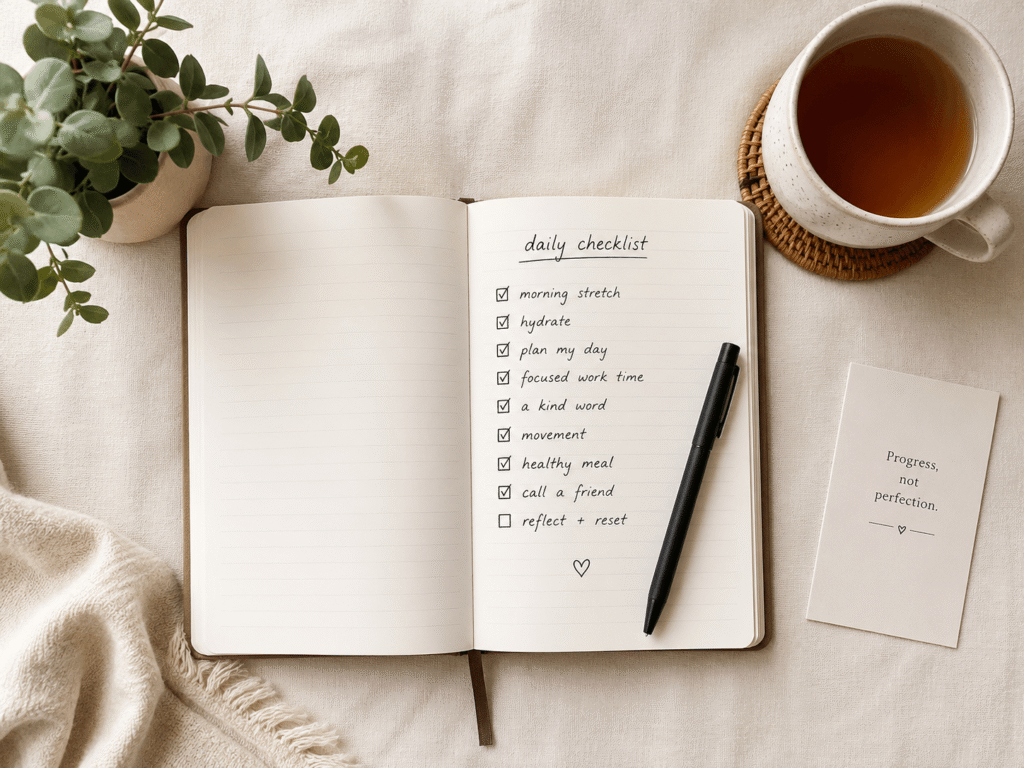
1. Pause and name the feeling.
“What am I actually feeling right now?”
• ☐ Physically tired
• ☐ Mentally drained
• ☐ Anxious
• ☐ Afraid of failing
• ☐ Bored
• ☐ Something else
Fatigue tends to point to rest. Anxiety or fear tends to point to avoidance.
2. Ask what you’re trying to escape.
Finish this sentence: “If I didn’t have to feel ________, this task would be so much easier.”
If a specific emotion shows up immediately, that’s avoidance talking.
3. Run the “already rested” test.
“If I woke up tomorrow completely rested, would I still want to avoid this?”
• No → you need rest.
• Yes → the problem was never the fatigue. It’s discomfort.
4. Check your intention.
“Am I taking this break to come back stronger, or hoping I won’t have to deal with this at all?”
• “So I can come back with more energy” → rest.
• “Maybe it’ll feel easier later” → avoidance.
5. Commit to the next move.
If it’s rest: pick your recovery (sleep, a walk, food, stretching, quiet) and set a return time.
If it’s avoidance: do the smallest possible version of the task. Read the email. Write one sentence. Make the call. Give it five minutes.
Before you step away from anything, ask yourself:
“When this break ends, will I be more ready to face this — or further away from it?”
That answer tells you everything.
Healthy Ways to Rest Without Sliding Into Avoidance
1. Set a real end time. “30-minute nap, then back to it” beats “I’ll do it later” because it’s a decision, not a shrug.
2. Pick activities that actually restore you. A walk, music, a nap, meditation — not just whatever’s easiest to fall into.
3. Match the rest to what you actually need. Physically tired → nap or stretch. Mentally drained → step away from screens, get outside. Emotionally tired → journal or talk to someone you trust.
4. Come back with one small step. This tricks your brain out of treating re-entry as a threat. Starting is almost always the hardest part — momentum shows up after, not before.
5. Accept that discomfort is part of doing anything meaningful. You already tolerate this by default at your 9–5. The resistance usually shows up specifically around the work that’s for you, because there’s no guaranteed paycheck attached to it yet. That’s not a sign to stop — it’s a sign you’re doing something that matters.
Common Mistakes to Watch For
1. Calling scrolling “recovery.” It isn’t. It’s just a different flavor of avoidance with better lighting.
2. Never taking breaks at all. Overworking creates the exact fatigue that eventually forces a much longer, less controlled rest later. Scheduled rest is cheaper than forced rest.
3. Rebranding avoidance as “self-care.” This is the most convincing trap your brain will ever build for you. Don’t fall for your own marketing.
4. Pushing through instead of taking a real break. A genuine 20-minute pause to finish something strong beats grinding through on fumes.
Conclusion
Rest and avoidance can look identical from the outside — same couch, same quiet, same “I’ll do it later.” The difference is what’s actually happening underneath, and that’s exactly why the 5-step self-assessment exists: to catch the moment before your brain quietly makes the decision for you.

If you’re genuinely exhausted, rest without guilt. Recovery isn’t a reward you unlock through productivity — it’s a requirement for doing this sustainably.
But if you’re avoiding something because it’s uncomfortable, know that progress was never going to start with motivation anyway. It starts with one small, annoying, uncomfortable step — taken before you feel ready for it.
Rest to restore. Act to grow. Learn to tell the two apart, and you’ll spend a lot less of your life avoiding it.










One Comment