Why Do We Procrastinate on Things We Actually Want to Do?
I procrastinated on something I genuinely wanted for six years. Not one, not two — exactly six. In 2020, I wanted to start my own website, a place to write freely and share what I knew. I researched it, got close to launching a basic blog, and then just… stopped.
If you’ve ever wondered why you procrastinate on the things you actually want to do — not chores, not obligations, but real goals — you already know this isn’t about laziness. This article is about what’s actually happening in your brain when “I’ll do it later” becomes a six-year sentence.
Here’s what happened to me:
COVID hit, and with it went my enthusiasm to build something of my own. I forgot writing was one of my passions. I was 20, fresh out of my teens, and in India — where working from your phone isn’t really seen as “real work” — that phone was my only tool.
My parents saw it as wasting time instead of job-hunting, and eventually I gave up. I don’t blame anyone for that. It was me against my own mind then, and some days, it still is.
Everything since has been a kind of trauma response to that first giving-up. It took me some time to figure out what actually works and what doesn’t. So let’s actually unpack what procrastination is, why it happens even when we care deeply, and what to do about it.
What Is Procrastination, Really?
When I asked Google to define procrastination, it gave me the textbook version:
“The act of unnecessarily delaying or postponing a task or decision despite knowing there will be negative consequences.”
Fair enough — but that still sounds a lot like being lazy. So I asked ChatGPT the same question, and its answer stuck with me :
“Procrastination is choosing to do something that feels better right now instead of doing what you know is better for later.”
That reframing changed things for me. Here’s what it looks like in practice:
• You want to study, but you watch another episode of One Piece instead.( one piece is an anime widely watched by people around the world)
• You want to exercise, but you watch productivity videos and call that research.
• You want to start a business, but you spend hours planning instead of taking the first step.
There’s a real distinction between laziness and procrastination:
• Laziness means avoiding the task entirely — you don’t care either way.
• Procrastination means intentionally delaying a task you do care about.
That distinction matters, because it means procrastination isn’t a character flaw. It’s a coping mechanism.
Why We Procrastinate on the Things That Matter Most
The common misconception is that we delay things because we don’t care about them. In my experience, it’s almost always the opposite — we delay the things we care about most, because caring raises the stakes.
Let me use an example I know well:
“I want to learn to play the guitar.” I’ve been putting this off for two years. why?
1. Fear of Failure

“What if I end up not being able to actually play?”
“What if this just isn’t for me?”
To protect your self-esteem, your brain sends constant signals telling you why you shouldn’t try. Ironically, the opposite fear works the same way.
2. Fear of Success
“What if I actually get good? Now people expect me to keep playing.”
The responsibility that comes with success can feel just as threatening as failure. This is the sneaky kind of procrastination — you know you’re capable, but you delay anyway because success asks something of you that comfort doesn’t.
3. Perfectionism
“I learned to play ‘Perfect’ by Ed Sheeran, but I can’t post it. I’m not good enough yet.”
You want to be perfect before anyone sees you try — but you can’t get better without feedback, and you can’t get feedback without being seen. Perfectionism doesn’t protect your progress; it delays it.
4. Emotional Avoidance
“It’s been two days and my fingers hurt so bad. Maybe I’ll pick this back up when it doesn’t hurt anymore.”
Learning something new is rarely pleasant in the beginning. Reminding yourself how uncomfortable the process is gives your brain all the ammunition it needs to convince you to quit — and most of the time, it works.
5. Lack of Immediate Reward
Our brains are wired to chase quick wins, and the internet is happy to oblige.
“She learned this song in a week — why can’t I?”
You conveniently ignore that everyone learns at a different pace, because your brain would rather use that comparison to talk you out of trying at all.
The Psychology Behind Procrastination
I’m not a neuroscientist, and I want to be upfront that what follows is my own simplified read on research I’ve come across — not a clinical diagnosis of how your brain works. But the framing has helped me, and it’s backed by real research on procrastination and emotion regulation.
Researchers who study procrastination — including Dr. Fuschia Sirois, a psychology professor at Durham University who has spent over two decades researching this exact topic — describe procrastination less as a time-management failure and more as a mood-repair strategy. In other words, we’re not asking “what will help me reach my goal?” We’re asking “what will make me feel better right now?” — and our brains reliably choose the second question.
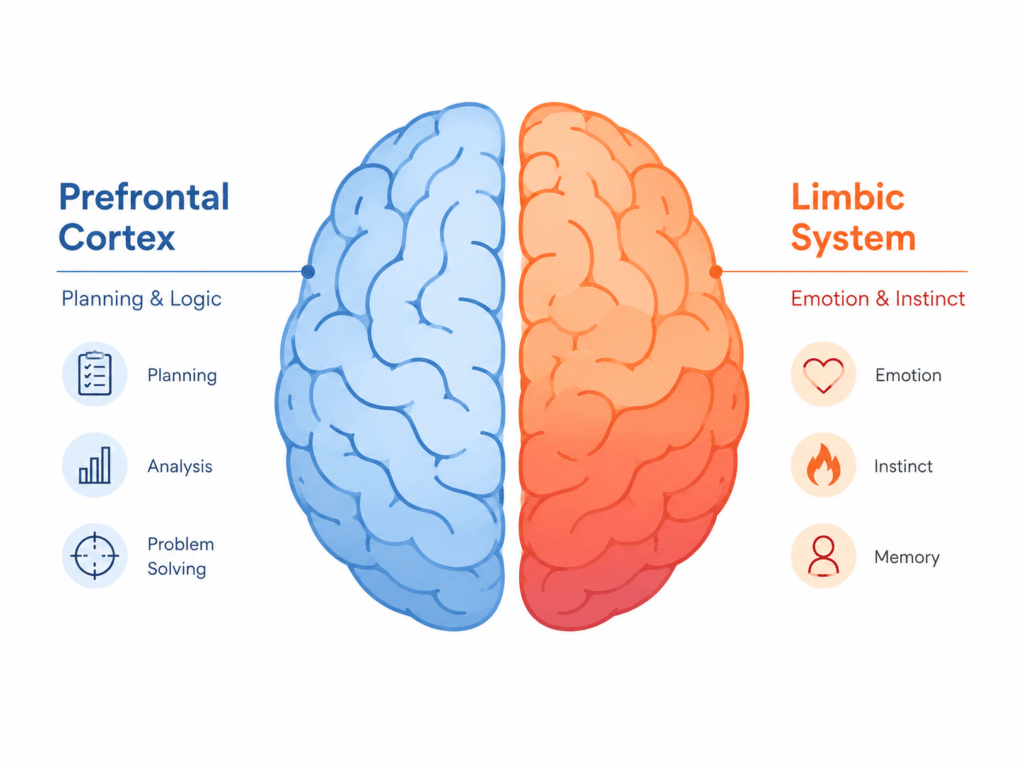
That instinct is often explained through the tension between two brain systems:
| The Prefrontal Cortex Handles | The Limbic System Handles |
|---|---|
| Planning | Emotion |
| Self-control | Fear |
| Decision-making | Reward-seeking |
| Future thinking | Threat detection |
Put simply: one system thinks ahead, the other reacts to the moment. When a task feels threatening — the limbic system tends to win.
A simplified way to picture the loop:
Important task → brain predicts discomfort → “avoid it” signal fires → you get instant relief → relief feels rewarding → brain learns “avoidance = comfort” → the task feels even harder next time.
The longer we put something off, the stronger our resistance to starting tends to become. This isn’t a moral failing — it’s a feedback loop your brain built to protect you from discomfort, and it can be retrained.
Why Motivation Isn’t the Problem
We tell ourselves, “I’ll start once I feel motivated.” But in practice, motivation usually shows up after you start — not before. It’s backwards from how we assume it works.
Waiting for motivation before you act tends to buy short-term comfort at the cost of long-term regret. Acting without motivation buys short-term discomfort — but it’s the version that actually moves you forward.
“Procrastination isn’t the absence of motivation. It’s the presence of emotional resistance.”
Signs You’re Emotionally Procrastinating
If you keep telling yourself “I’m just lazy,” but deep down you still want to do the thing — just not right now — that’s a sign worth paying attention to. Some patterns to watch for:
1. You keep finding reasons to push the task to later.
2. You focus on planning it perfectly instead of just starting.
3. You suddenly get busy with a less important task, just to feel productive.
4. You keep waiting for the “right moment,” and your research never ends.
5. You watch productivity content instead of doing the thing the content is about.
6. You feel guilty about procrastinating, then repeat the exact same cycle.
Recognizing these patterns is the first step. Here’s what’s actually helped me break them.
Practical Strategies That Actually Work
1. The Two-Minute Rule

When your brain resists a task, commit to just two minutes of it. Want to learn guitar? Start by tuning it — that’s it. That’s the whole task for now.
Why it works: Doing something, even briefly, signals to your brain that you’re in control. Motivation tends to follow action, not the other way around.
2. Time Blocking
Assign a specific time to the task, the same way you’d block time for a meeting. For example: 4:00 PM – Practice guitar.
If your brain resists when 4 PM rolls around, fall back on the two-minute rule anyway. Afterward, write down how it felt to follow through — that record becomes its own kind of reward.
3. Focus on Starting, Not Finishing
Overthinking is often the real driver of procrastination — your brain gets overwhelmed asking “how will I ever finish this?” before you’ve even started.
The truth: you can’t know how to finish until you start. Show up for a few minutes daily, and your brain eventually catches up to finishing the task on its own. (This exact approach is how this article got written, by the way.)
( Here we have a few tactics on “How to stop Overthinking”. Might help you control the spiral when you go through those difficult phases of life.)
4. Self-Compassion Over Self-Criticism
Research by psychologists Michael Wohl, Timothy Pychyl, and Shannon Bennett, published in Personality and Individual Differences (2010), found that students who forgave themselves for procrastinating on an exam were less likely to procrastinate on the next one.
Later work by Dr. Fuschia Sirois has linked self-compassion — rather than self-criticism — to lower stress and reduced procrastination over time.
In plain terms: beating yourself up for procrastinating tends to make you procrastinate more. Forgiving yourself, then trying again, tends to work better.
5. Environment Design

Your surroundings shape your follow-through more than most people give them credit for. If you live alone, build a space that makes the task inviting — good lighting, an instrument within reach, whatever removes friction. If you live with others, use that to your advantage:
an audience means feedback, and feedback — even the critical kind — can push you to improve faster than working in isolation.
Common Mistakes to Avoid
1. Waiting for motivation. Action tends to create motivation, not the reverse.
2. Comparing your Chapter 1 to someone else’s Chapter 100. In an attention economy full of highlight reels, this comparison is rarely fair to you.
3. Setting huge goals before you’ve taken a single step. Start small; the goal comes into reach over time.
4. Punishing yourself for missed deadlines. You have 365 days a year and (statistically) decades ahead of you. Slow down.
5. Multitasking too early. Trying to learn guitar, music theory, and piano in the same week is a fast track to burnout. Pick one thing.
The Takeaway
If you’ve been procrastinating on something that genuinely matters to you, it doesn’t mean you’re lazy, undisciplined, or incapable. More often, you’re protecting yourself from fear of failure, perfectionism, uncertainty, or plain emotional discomfort. This isn’t a personality flaw — it’s a habit your brain built to chase short-term comfort, and habits can be rebuilt.
Taking one small step, repeated consistently, compounds into something bigger than motivation ever could. Start today with the one thing you’ve been putting off — even if it’s just two minutes of it — and do it again tomorrow.
The life you want isn’t built in a moment of motivation. It’s built in the small decisions you make when you’re not motivated at all.
Start small. Stay consistent. That’s the whole method.