
How to Build a Productive Morning Routine That Actually Sticks (2026)
If you clicked on this looking for a productive morning routine, here’s the first thing you need to do: put your phone down. I know, I know — not exactly the groundbreaking advice you were hoping for.
But stay with me, because how you put it down, and what you do in the next four hours, is where this gets interesting.
We live in a world built to reward billionaires, millionaires, and — sure, why not — the odd trillionaire. Good for them. But most of us are still stuck in the infinite scroll, and escaping it starts with what you do in the first few minutes after you open your eyes.
A productive morning routine only becomes sustainable when it’s simple, personalized, and built through small, consistent habits — not drastic overnight changes.
Why Your Morning Routine Matters More Than You Think

In my early twenties, “routine” wasn’t even in my vocabulary. Life felt too random for structure. Then I turned 26, and the regret hit — hard.
The first real change I made was cutting my social media use, starting the moment I opened my eyes each morning. That one shift is the honest answer to “why does a morning routine matter?” It wasn’t a five-step system. It was one small decision, repeated daily, that eventually reshaped everything else.
This isn’t a scientific claim — it’s what worked for me. But it lines up with something researchers have actually measured.
The Real Reason You Reach for Your Phone First
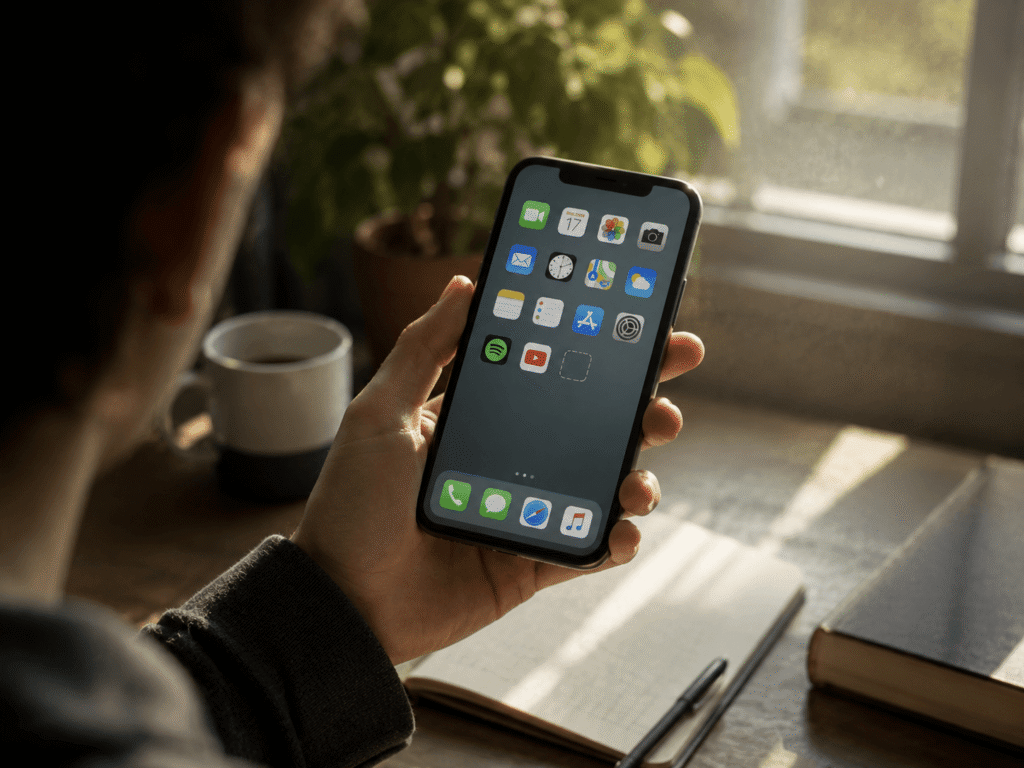
You don’t need a productivity guru to tell you the standard list — wake up early, drink water, stretch, meditate, eat well. Your brain already knows this. We’ve just been trained to forget it, one notification at a time.
Here’s the part that isn’t just my opinion: several recent studies have looked at what happens in your body when a phone is the first thing you touch after waking.
• Cortisol — your body’s main stress hormone — follows a natural curve after you wake up, climbing steadily and then jumping again once you’re exposed to daylight. That’s your body’s built-in wake-up mechanism, working fine on its own.
• One study tracking people’s cortisol after waking found that pulling up notifications within the first half hour pushed those levels noticeably higher than in people who waited.
Takeaway : Starting your day reactively — responding to other people’s demands before you’ve set your own — is linked to higher stress. Starting proactively is a choice you get to make in the first five minutes of being awake.
(Opinion vs. evidence, clearly separated: the science above supports the idea that early phone use spikes stress. What follows — my specific method — is personal experience, not a clinical protocol.)
The Phone-at-Your-Feet Experiment

Here’s the exact experiment I used to break the phone-first habit. Try it tonight.
1. The night before: Switch off your phone and place it near your feet — not your head.
2. Before closing your eyes: Say out loud, “I have to wake up at 5 a.m. tomorrow.” Say it twice with your eyes open, then twice more with your eyes closed. Then sleep.
3. When you wake up: You’ll instinctively reach for your phone — but it’s at your feet, which forces you out of bed to get it.
4. The redirect: The moment your hand touches the phone, say instead, “I need to drink water now,” two or three times. Then get up and go get that water.
That’s it. That’s the whole win for day one. Congratulations — you just interrupted your own autopilot.
How to Structure Your First Four Hours

Say your shift starts at 9 a.m. and you’re up at 5. That gives you five hours — and the first four, before your brain fully “clocks in” to the outside world, are the most valuable ones you’ll get all day.
Here’s how I split mine:
• Hour one: Drink water, set your intention for the day, no phone.
• Hours two through four: Exercise or yoga, meditate, journal, or work on a side project — whatever matters most to you, done while your mind is still raw and undistracted.
• 8 a.m.: Phone comes off the charger (yes — charge it in another room). Now you can catch up on messages and get ready for work.
You get exactly four hours of undivided, undistracted productivity. Protect them.
How to Make This Routine Actually Stick

Here’s the honest part: you probably won’t see physical results right away. For me, visible changes to my body took two full years. What changed fast — within a week — was how I felt about myself.
That timeline isn’t just anecdotal, either. A well-known habit-formation study out of University College London, led by psychologist Phillippa Lally, tracked people building new daily habits and clocked automaticity at an average of 66 days — though individual results ranged all the way from 18 days to 254 days. Give yourself real time, not a TikTok deadline.
A few things that helped me stay consistent:
• Rotate the routine, don’t repeat it identically. I go for a walk one day, strength train for two, and do yoga for two — never more than an hour each.
• Expect boredom, and plan for it. If the same four steps every day start to feel like a chore, swap the order or swap the activity. The four hours are yours to shape.
• Forgive the missed days. Lally’s research found that missing a single day didn’t derail participants’ progress toward automaticity — so don’t let one off morning talk you out of the whole thing.

Morning is where you make it or break it. Consistency is the whole game — not perfection, not intensity, just showing up in a way you can repeat tomorrow. I won’t pretend this works 100% of the time. I’ll guarantee 99% of the result and leave the last 1% for the ones who will actually manage to stick to the routine.
The best morning routine isn’t the most complicated one. It’s the one you can actually repeat.









One Comment