
Imposter Syndrome Isn’t a Confidence Problem. It’s a Comparison Problem.
If you’re here, you’re probably a capable person who knows you’re smart enough — and still feels like a fraud. You’ve probably also been told to “just be confident,” like that’s a switch you can flip. It’s not. The people telling you that are usually asking themselves the exact same question five minutes later.
Imposter syndrome doesn’t come entirely from a lack of self-belief. It comes from who you’re measuring yourself against.
I used to work a job that put me in constant contact with highly accomplished people. The kind who seem too important to make small talk with a stranger. Every time one of them struck up a conversation, my brain ran the same loop: is it okay for me to be talking to this person? Why would he want to talk to me?
The conversation would go on for fifteen, twenty minutes. I’d walk away relieved that I actually managed to hold a conversation with them. Then I’d tell myself it was luck. Just a fluke.
What I never let myself sit with is, if I truly wasn’t deserving of that conversation, it probably wouldn’t have lasted twenty minutes. When I got back and told my coworkers what we talked about, they’d tell me I had a gift for conversation. My brain went straight past that, to “No, it was just the uniform. I was a flight attendant working in business class.”
Confidence was never my problem. I’d spent years building it, deliberately. But it kept getting undermined anyway, for no reason I could name. Comparison was the actual culprit, and it took me a while to see it.
What Is Imposter Syndrome?
Imposter syndrome is the persistent feeling that you don’t deserve your success — that whatever you’ve achieved is down to luck, timing, or other people’s help, not your own ability. No matter how competent you actually are, there’s a low voice in the back of your head telling you that once people realize you’re not that good, it’s over.
I felt this hard when I started writing online. I’d kept a diary and posted small pieces since 2012, but I never once called myself a writer. People reacted well to what I wrote, and I never took it seriously. Writing brought me real joy every time I sat down to do it, but I was still working hard not to compare myself to writers I admired, because the second I did, everything I’d written started to feel invalid.

The symptoms showed up in patterns :
• Constant self-doubt
• Fear of being “found out”
• Guilt when something goes well
• Anxiety before major milestones
• The persistent sense of being a fraud
None of that was actually true of me. Everything I wrote or said was honest, and came from somewhere real. It’s a phase though, not who you are — a thought pattern that sticks around for a while and loosens its grip once you keep showing up authentically.
Psychologists Pauline Clance and Suzanne Imes first named the impostor phenomenon back in 1978, and research reviews since then put the number of people who experience it somewhere around 70%, though later reviews found the range runs anywhere from roughly 9% to 82% depending on how it’s measured. Even people who are extremely accomplished by any outside measure report feeling this way. Being smart doesn’t make your brain immune to it.
Why low-Confidence Isn’t the Real Problem
“Whether you think you can or think you can’t — you’re right.” — Henry Ford
Most high achievers have heard this quote, and most of them actually live by it. They believe they can, and they do. Low-confidence was never the missing piece.
You can have the Lamborghini, the Porsche, the life that looks finished from the outside, and something can still feel off. And the next thought that shows up usually isn’t “I need more confidence” — it’s “my neighbor, who also has a Lambo, seems to have this figured out better than I do.” Meanwhile, that neighbor is probably looking at your life and thinking the exact same thing in reverse.
Two high achievers, both convinced the other one is doing it right. If comparison weren’t in the mix, this wouldn’t happen — both of them would just be living their own lives, unbothered.
And if you’re reading this thinking “I don’t even have a Porsche, maybe I’m not a high achiever” — that’s the comparison instinct doing exactly what this article is about. Keep reading, there’s a way out of it.
How Social Comparison Fuels Imposter Syndrome
Comparison sits underneath almost every version of this feeling. Imposter syndrome was never really about doubting your abilities on their own terms — it’s about measuring your abilities against someone else’s highlight reel.
Notice when the “I haven’t done enough” feeling shows up. It’s rarely random. It’s usually right after you’ve run into someone who’s achieved a bit more than you have. That moment doesn’t just dent your confidence, it pulls you into upward comparison, and upward comparison always lands in the same place: not enough.

Psychologists tie this to a few specific patterns:
• Believing you’re not enough, full stop
• Doubting competence you’ve already demonstrated
• Feeling like you don’t belong in the room
• Discounting your own progress because it doesn’t look like someone else’s
Social platforms make this worse by design. LinkedIn, Instagram, YouTube hand you a constant, context-free stream of other people’s wins, and your brain treats every one of them as a data point about your own worth.
Comparison doesn’t make you incompetent. It just makes you feel that way. Learning from people you admire is fine. The problem starts when comparison enters the chat and starts making you feel less worthy.
(Some links in this post are affiliate links, which means I may earn a commission if you purchase through them — at no extra cost to you.)
The Psychology Behind It
I came across Dr. Valerie Young’s book, The Secret Thoughts of Successful Women, while researching this. She’s one of the most cited researchers in this space, and her core idea reframes the whole thing: people with imposter syndrome don’t question what they did. They question who they are.
A few specific mechanisms drive that:
Perfectionism
When success only counts as being flawless, even a small mistake reads as proof of incompetence. You end up chasing an error-free version of yourself instead of learning from the errors you actually make, and the mind fills in the gap with “you don’t belong.”
Social Comparison
We tend to measure ourselves against people who are further along a path we’ve barely started. It’s not a fair comparison, but it’s an automatic one, and it erases the fact that everyone is on a different timeline.
Attribution Bias
If your instinct, every time something goes well, is to credit luck, timing, or someone else’s help instead of your own effort, that’s attribution bias, and it’s one of the clearest markers of imposter syndrome. Left unchecked, it stops you from ever building an accurate picture of your own competence.
Unrealistic Standards of Competence
Dr. Young identifies a few common, and impossible, rules people hold themselves to: you must be perfect, you must know everything before you’re “allowed” to be qualified, asking for help is weakness. When you inevitably fall short of standards no one could meet, it registers as personal failure instead of normal human growth.
The Comparison Loop
The easiest way to portray this is :
You see someone successful
↓
Compare yourself
↓
Feel inadequate
↓
Discount achievement
↓
Work harder
↓
Temporary success
↓
Find someone better to compare
↓
Repeat
It’s a loop, and the real cost isn’t just your confidence. Comparison blurs out the evidence your brain needs to actually judge your own competence accurately.
Signs Comparison Is Driving Your Imposter Syndrome
1. You dismiss compliments.
No matter how much praise you get, some part of you argues it doesn’t count. The relief from a compliment is real but short, and comparison brings the doubt right back.
2. Success feels accidental.
My first-ever interview, for a flight attendant role at a well-known airline, landed the job. To this day, I still chalk that up to coincidence. My parents were proud. I never let myself be.
3. You keep moving the goalpost.
Celebrating a win doesn’t feel allowed. There’s always the next target, and the current one stops counting the moment you hit it.
4. Someone else’s success sours your mood.
If watching someone else thrive makes you feel worse about your own life, that’s usually comparison talking, a sign you’ve lost sight of the fact that everyone’s on their own timeline. That doesn’t make you a bad person, it just means it’s worth paying attention to.
5. You chase validation.
For most of my life, I was stuck chasing it, starting in school, doing extra work to stay in a favorite teacher’s good graces, mostly for the payoff of her telling my parents I was a “good kid.” It never actually did anything for me. Years later, I realized I was getting nothing but a quick hit of approval from people who didn’t particularly care either way, and that’s what actually started breaking the cycle for me.
Breaking the Comparison Cycle
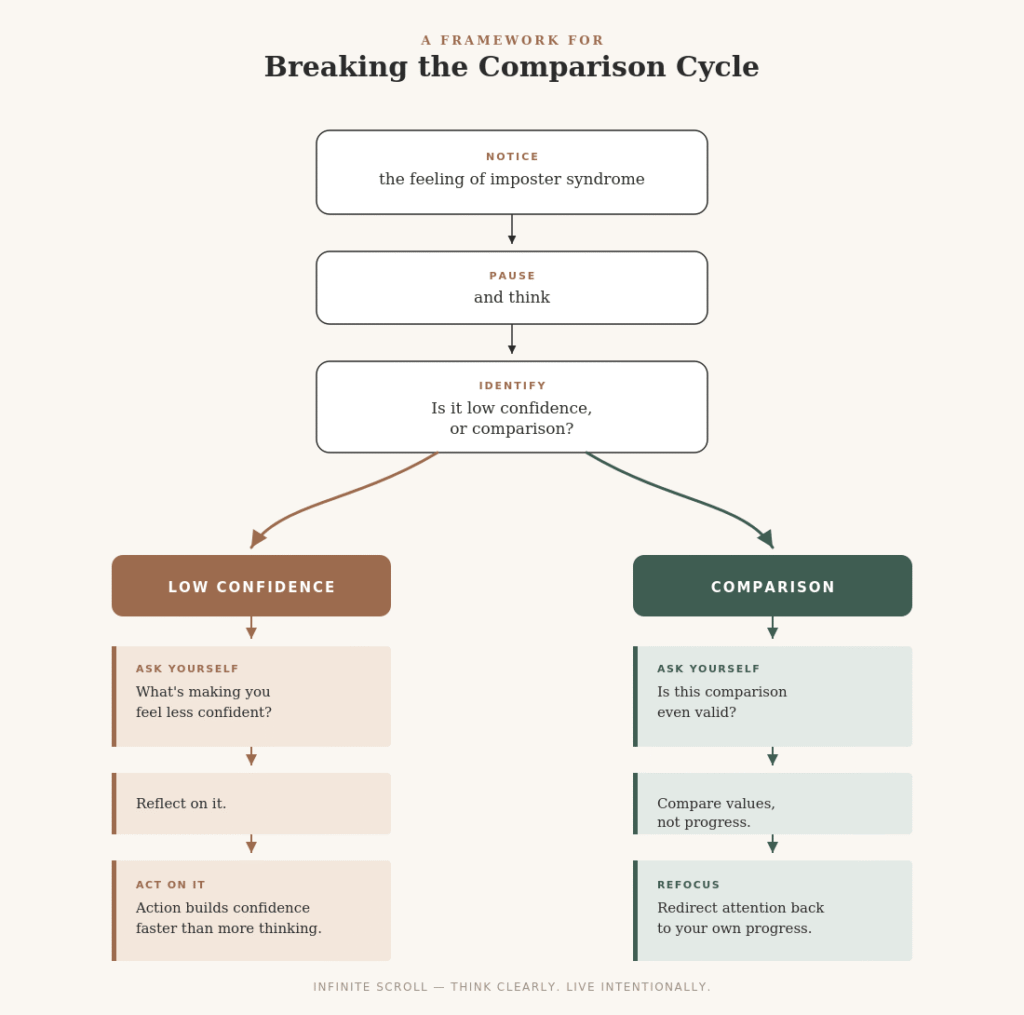
This is the framework that’s worked for me. Whenever the feeling of “something’s not right, I don’t belong” shows up:
Notice the feeling → Pause and think → Identify whether it’s low confidence or comparison.
If it’s low confidence: Ask what’s actually making you feel unsure → reflect on it → act on it quickly, because action rebuilds confidence faster than more thinking does.
If it’s comparison: Ask whether the person you’re comparing yourself to is even a fair comparison → shift from comparing progress to comparing values → redirect your attention back to your own trajectory.
Practical Self-Assessment (2 Questions)
Even with all of the above, the feeling will still show up sometimes. Most of us picked up these thought patterns young, and they don’t fully go away just because you understand them now. When it does, two questions help:
1. “What evidence do I have that I don’t belong, and what evidence suggests I do?”
2. “What are three things I’m grateful for right now?”
After the second question, take four slow breaths. Moving from question one to question two, from defending yourself to noticing what’s actually going well, is usually where the feeling starts to let go.

Final Thoughts
One article won’t make imposter syndrome disappear. But knowing that comparison is driving it, not a lack of confidence, changes what you actually do the next time it shows up.
Start with the two-question check-in above the next time the feeling hits. Sit with your answers for a minute before you move on, and see what changes.
Research Sources :
• Clance & Imes’ original 1978 paper, “The Imposter Phenomenon in High Achieving Women” .
• Dr. Valerie Young’s The Secret Thoughts of Successful Women
• Sakulku & Alexander (2011), “The Impostor Phenomenon,” International Journal of Behavioral Science