
How to Stop Overthinking: 5 Tactics That Actually Work
I once overthought myself straight into a police station. Not a metaphor — an actual police station, at 9am, over a decision I’d made the night before out of nowhere but my own anxious brain.
If you’re here because you want to know how to stop overthinking, that story is basically the entire case for why it matters. Your reality gets shaped by the thoughts you replay at 2am — and left unchecked, those thoughts don’t just live in your head. They start making your decisions for you.
Here’s what happened, why it happens to all of us, and the five tactics that actually pulled me out of the spiral — not “just relax” advice, but the specific things I do the moment I catch myself starting to unravel.
The Night My Overthinking Sent Me to a Police Station

I once helped a middle-aged woman who approached me asking for money.
In the moment, I did what felt right — I helped her out. I should have stopped there. But as an overthinker, I didn’t.
That night, before I fell asleep, the spiral started.
What if she was acting? What if she was mixed up with bad people? What if I just funded a drug habit?
It was unstoppable. If there were a marathon for overthinkers, I would’ve won that night. And the spiral didn’t stay in my head — it walked me straight into a police station the next day.
Here’s the twist: the lady actually was wanted, for theft. I’d been caught with her on CCTV, so I had to explain myself, though I did get my money back. The “win” cost me half a day of unpaid work.
The moral isn’t “trust your gut, you’ll always be right.” It’s that I manifested a stressful situation out of a spiral that didn’t need to happen. If I’d given the moment less weight, I probably could have avoided the entire mess — the police station, the lost wages, all of it.
That experience left me with one real question: why do we overthink in the first place?
Why We Overthink
In my experience, understanding why you overthink is the first step to loosening its grip. Overthinking tends to show up as a response to fear of failure — emotional failure, fear of judgment, uncertainty, or just not feeling “enough.” It convinces you that if you analyze every possible outcome, you’ll land on the one right decision. In practice, it does the exact opposite.
This isn’t just a personal theory — it’s well-documented in psychology. Yale psychologist Susan Nolen-Hoeksema, whose decades of research essentially built the modern understanding of rumination, found that dwelling on distress is a major factor behind why overthinking is so widespread — and why women in particular report it at higher rates than men.
Her broader body of work shows that rumination doesn’t just feel bad in the moment: it amplifies negative thinking, impairs problem-solving, and can get in the way of actually doing something about the problem.
Overthinking doesn’t protect you from bad decisions. It often causes them.
That’s the loop:
overthink → lose clarity → make a worse decision → regret it → overthink about that.
It’s not a character flaw. It’s a pattern — and patterns can be interrupted once you can see them.
Why It’s Hard to Spot the Pattern
It’s a strange, quiet law of the mind: a pattern only loosens its grip once you actually see it as a pattern. For me, that took about eight years.
Growing up with internet access where I could watch other people’s stories helped. I recognized my own spiral the first time I saw a stranger online describe the exact thoughts I’d been having — and how they’d worked through them.
My mother’s generation didn’t have that. She grew up with a different set of “rules” about how you’re supposed to think and behave, and she still repeats the same worry patterns without fully naming them as patterns.
To be honest, my mother had a different information environment. Their spirals are shaped differently than ours. When I found tactics that worked for me, I quietly started using them with her too, without turning it into a lecture about “You do not tell me what to do.”
5 Tactics to Interrupt an Overthinking Spiral
Here’s what’s actually worked for me — not textbook advice, but tested-in-real-life tools.
1. Challenge the Worst-Case Outcome
You’re not going to shut your brain off mid-spiral. It’s already running. So don’t fight it — redirect it.
Let your mind go straight to the worst-case scenario. Then, instead of stopping there, ask: what would I actually do if that happened?
Say you’ve got a job interview tomorrow and your brain is spiraling. The worst case is you don’t get the offer, despite doing your best.
The next question is: then what? Maybe the honest answer is “I apply somewhere else.” Once you’ve actually got an answer, the fear loses a lot of its power — you’re no longer afraid of the unknown, because you’ve already met it.
2. Focus on What You Can Control
Once you’ve defused the worst case, shift your energy toward the parts of the situation you can actually influence.
For that same interview, the thing you control is your preparation — not the outcome. Your thoughts belong to you. Other people’s opinions only affect you to the degree you let them in; you still get to decide what to accept and what to let pass through. Put your energy into what’s yours to control.
3. Use the 5-4-3-2-1 Grounding Technique
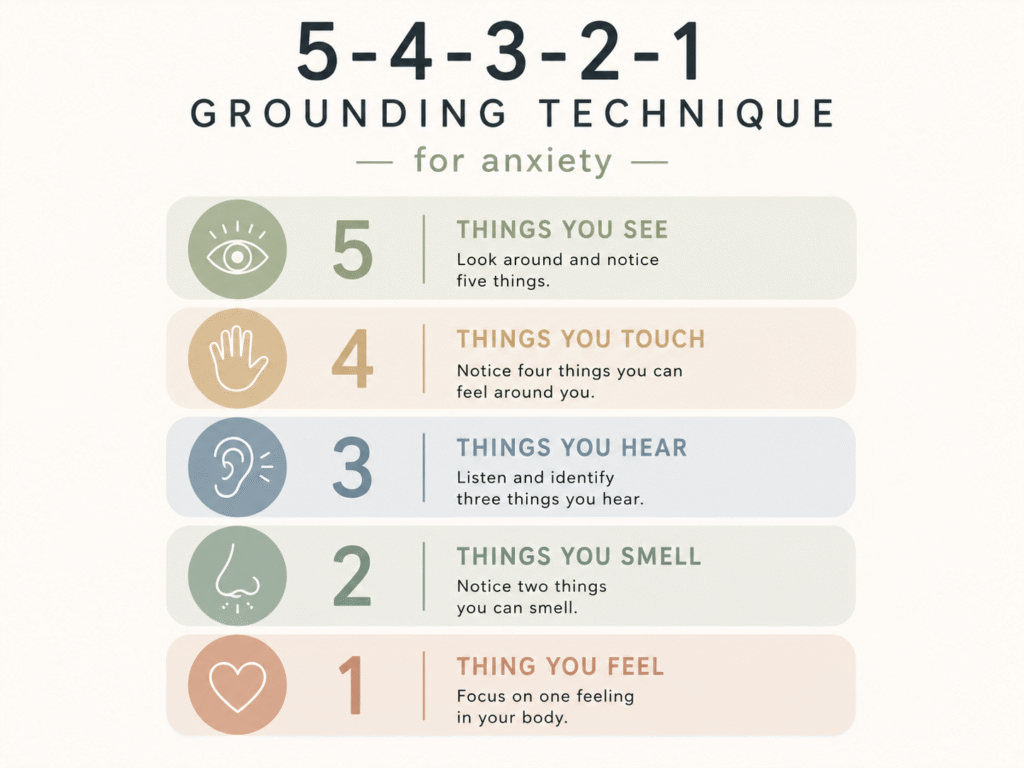
This one’s been the biggest game-changer for me personally. The moment you notice you’re spiraling:
• Name 5 things you can see
• Name 4 things you can touch
• Name 3 things you can hear
• Name 2 things you can smell
• Name 1 thing you can feel in your body
This is a well-known sensory grounding exercise used in anxiety management — it works by pulling your attention out of the loop in your head and back into your physical surroundings, which makes it much harder to keep spiraling on autopilot.
4. Take One Small Action
The instant you catch yourself overthinking, stop. Get up. Drink some water. Then do something that occupies your attention enough that there’s no room left to spiral — a Netflix episode, a documentary, a walk, a phone call. You’re not avoiding the problem; you’re interrupting the loop long enough for your nervous system to reset.
5. Move Your Body

A short walk, a stretch, a run, or a lifting session can interrupt a repetitive thought pattern almost immediately. This isn’t just a wellness cliché — a growing body of research backs it up.
A 2026 review in Frontiers in Psychology found that a single moderate-intensity aerobic exercise session can rapidly reduce rumination by shifting attention away from repetitive thoughts and toward the activity itself. Other clinical studies have found similar effects: even one bout of exercise measurably improves mood, lowers anxiety, and reduces depressive symptoms.
So next time you feel the spiral building, don’t wait until you’re already stuck. Get moving first.
Daily Habits That Reduce Overthinking Over Time
Interrupting a spiral in the moment is one thing. Preventing so many spirals in the first place is another. These habits take more consistency, but in my experience, they compound.
1. Start your morning without your phone. A calm first 20-30 minutes sets the tone for the rest of the day.
2. Practice mindfulness early in the day. Even 10 minutes of meditation after waking up helps.
3. Limit information overload. The more content — especially social comparison content — you consume, the more raw material your brain has to spiral on. Unfollow accounts that make you feel inadequate.
4. Make small decisions faster. You don’t need 20 minutes to decide what’s for dinner. Practice deciding quickly on low-stakes choices; it builds the muscle for bigger ones.
5. Schedule a “worry window.” Give yourself a defined slot to worry — not right before bed, not right after waking. Telling your brain “later” is more effective than most people expect.
6. Practice gratitude. Regardless of how the day went, naming what you’re grateful for shifts your baseline mood more than it sounds like it should.
When to Seek Support
Not every overthinking spiral is something you can tactic your way out of — and that’s worth saying plainly. Consider reaching out to a mental health professional if:
• Your thoughts feel impossible to shift, no matter what you try
• You’re constantly anxious or emotionally drained
• Your sleep is consistently disrupted
• You’re noticing symptoms of anxiety or depression
• It’s interfering with your daily life or physical health
None of this is a substitute for professional care — it’s what helped me personally. If overthinking is significantly affecting your life, a therapist can help in ways a blog post can’t.
A 5-Minute Overthinking Checklist

Screenshot this and run through it the next time you catch yourself spiraling:
• Have I taken my medication today, if I’m on any?
• Am I about to get my period? (Doesn’t apply to everyone — but hormones are real.)
• Have I eaten recently?
• Have I talked to another human being, in person, today?
• Have I engaged with a hobby recently?
Sometimes the spiral isn’t really about the decision at all. It’s about your body asking for something basic.
Grab the free 5-Minute Overthinking Reset worksheet — built from everything in this article. Subscribe to get it sent straight to your inbox.
Final Thoughts
Overthinking quietly eats away at your joy — one “what if” at a time. Almost everyone has spiraled over something at least once, and a lot of us are still figuring out why we keep landing in the same loop.
It’s never too late to interrupt the pattern. I made plenty of mistakes in my 20s, and I’ve made peace with that. People are going to have opinions about you either way, so you may as well live fully instead of bracing for judgment that was coming regardless.
You don’t have to solve every possibility. Sometimes the bravest thing you can do is trust yourself enough to take the next step.










2 Comments